UPDATES:
Almost eleven years ago, I started upgrading my modest college stereo system, turning it into a modest surround sound system. The surround system that I assembled over the course of 1997 went almost unchanged until the early fall of 2000 (I added a DVD player in late '98). A receiver upgrade in 2000 triggered a chain reaction of sorts, and the system has evolved a great deal since them. The receiver that started it all was Outlaw Audio's Model 1050, and in addition to providing me with access to both Dolby Digital and DTS for the first time, it led me to a major speaker upgrade and eventually to home theater separates – first just an amp to supplement the 1050, but later a surround sound processor to replace it. The Model 1050 was also my first taste of hardware from an internet direct manufacturer.
In a change of pace for me, I'm sitting at the keyboard today to compile some thoughts about equipment that I am using in a two-channel system – not the home theater setup that lives in our den. A series of events has led me to assemble a relatively simple stereo system in our dining room. This new system will play mostly CD's, with a few SACD's and DVD-Audio discs thrown in for good measure. And in a fitting homage to the first internet direct component that I bought back in 2000, this system ended up consisting almost entirely of internet direct hardware. Here's the list:
I'm still contemplating whether or not I will try to track down a small display to aid in seeing the 980H's on-screen menus. Doing so would make it easy to play CD-R's and DVD-R's full of MP3 files as well as simplifying DVD-Audio menu navigation, but for now I'm doing without that.
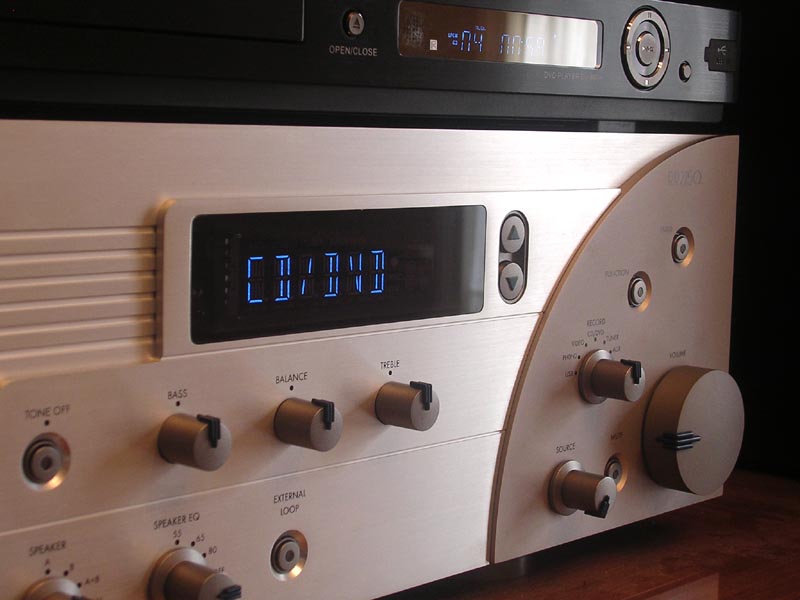
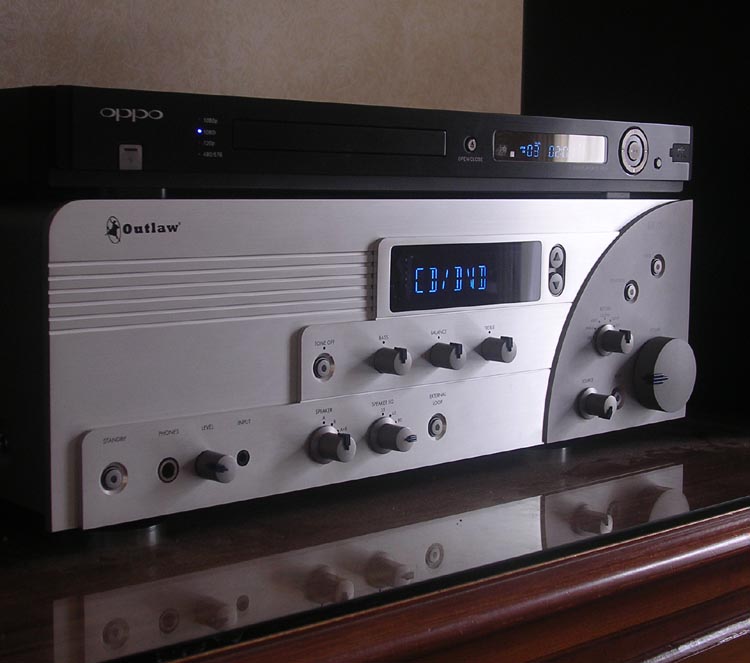
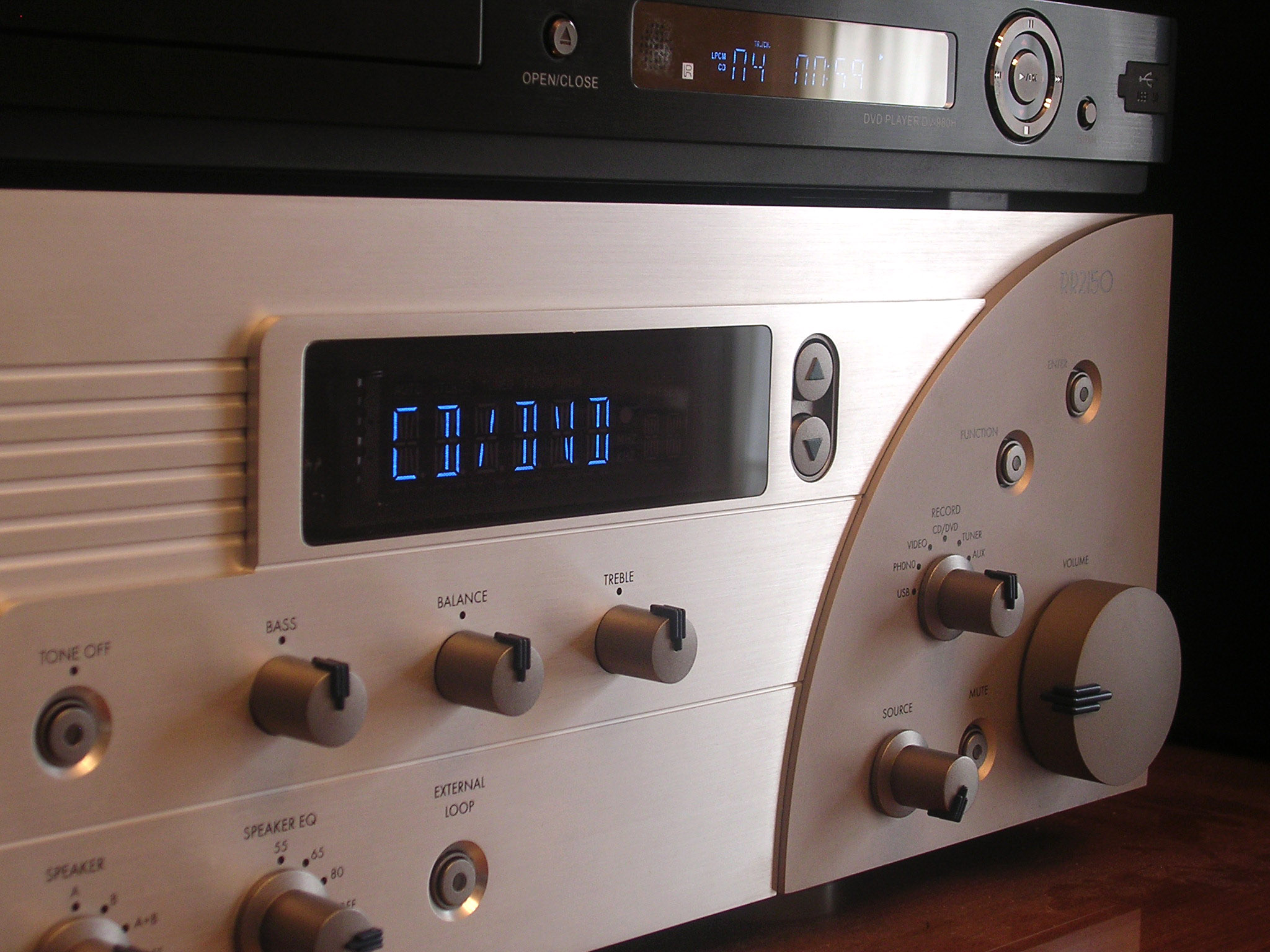
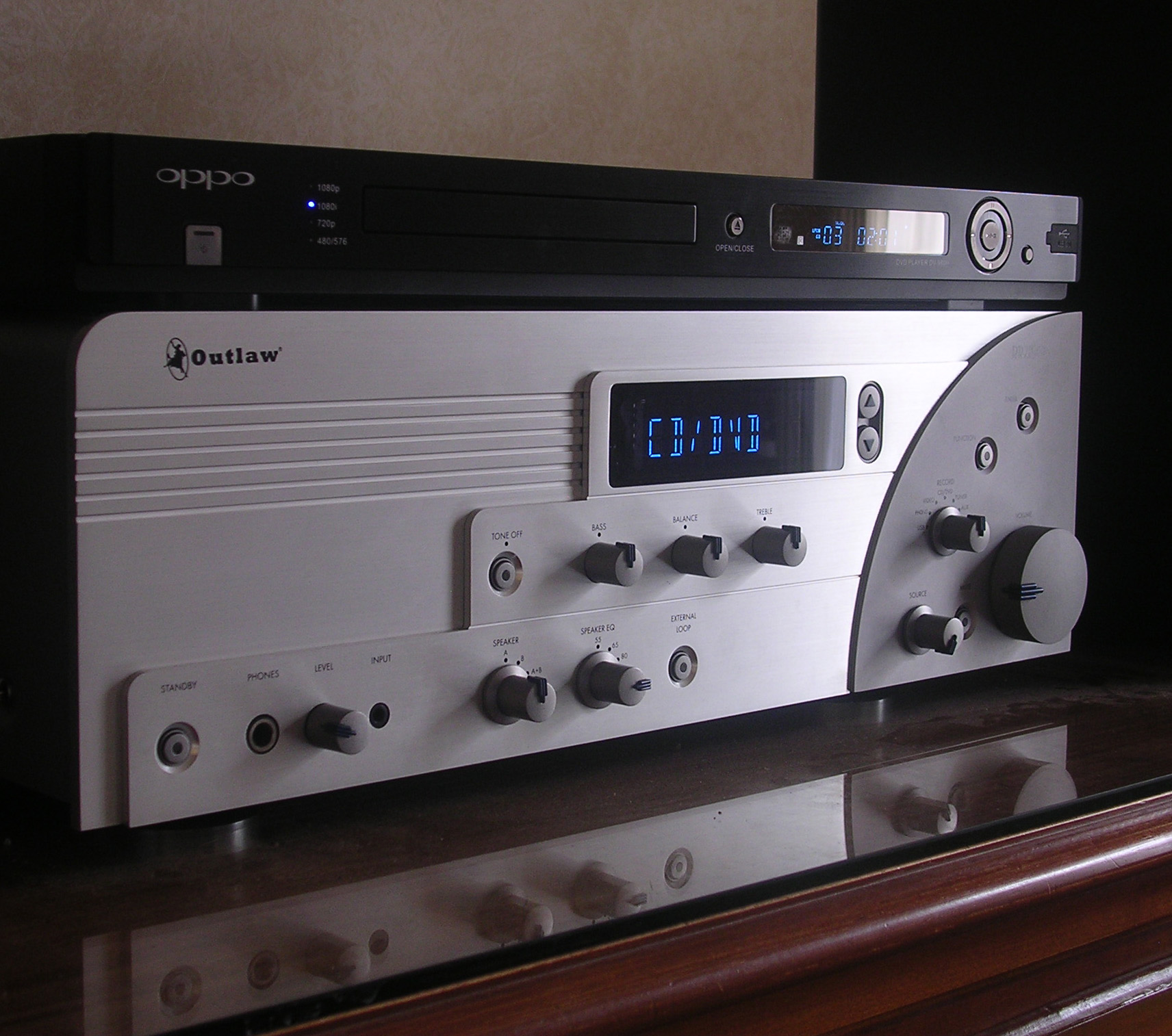
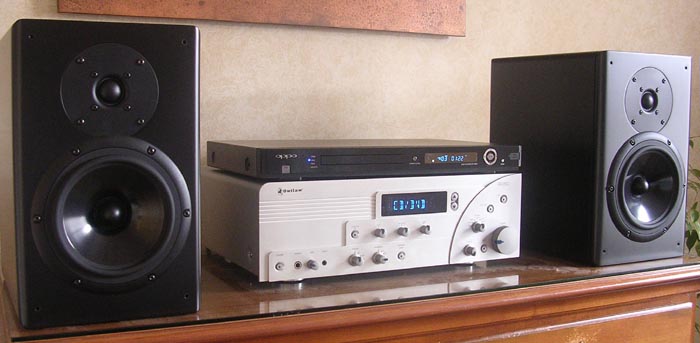
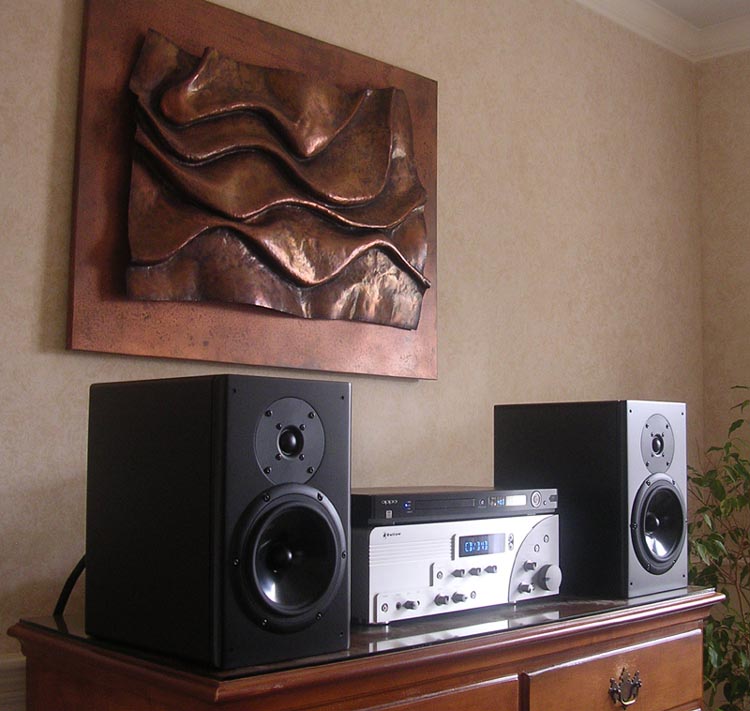
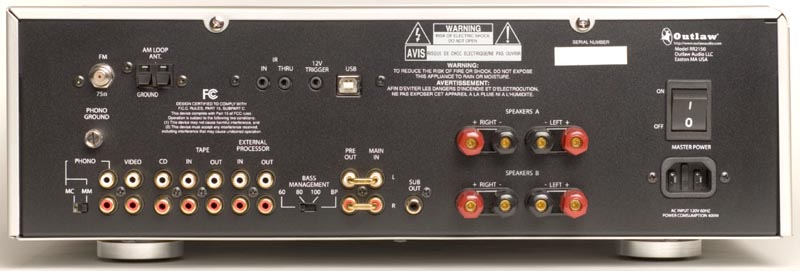
The RR2150 is a unique product for Outlaw. It deviates drastically from Outlaw's long-standing tradition of understated black front panels (particularly the early "green button" Outlaw products whose styling I've described as "aggressively utilitarian" in the past). Instead, it goes for a complex multi-piece milled aluminum face that retains the aluminum finish. Pictures just can't explain what this faceplate looks like. Since I grew up around complex metal-working as the son of a master metalsmith, I often look at things like this with a different sort of eye, and my mechanical engineering degree just reinforces that. The design of this faceplate really intrigues me. It is assembled from multiple pieces, something that is difficult to spot until you see one in person. It's a bold design, doubly so for a company known for seeking out more spartan architecture. When framed by a pair of smooth black boxes and a very low-profile black DVD player, the faceplate "pops" very nicely. The bright blue LCD display is a good color match to the blue of the 980H's display and is very easy to read from a distance. The blue detailing on the knobs also ties in well with the display. It's a very striking package overall, and one that I quite like - especially in contrast to soft lines of the copper panel hanging above it. As has been mentioned by some RR2150 owners, the knobs can exhibit some looseness or "play" in the controls, but it's something that I've only noticed with the volume control and it hasn't affected my ability to adjust the volume. The overall fit and finish is very good.
AV123 has offered a broad array of products over the last several years. They serve as something of an umbrella organization for a number of different product lines. Perpetual Technology is their oldest remaining in-house "brand," but it was the Rocket speaker line that really helped put them on the map. In addition to the Rocket line, they also have had a long-running Onix Reference line and a newer Strata line (currently consisting solely of the Strata Mini speaker). A couple years ago, however, AV123 president/owner Mark Schifter decided to create another new product line called the X-Series that he would use to make budget speakers and electronics. After a long development cycle, the first X-Electronics are still a couple months away, but the speaker line has been available for a while now. The X-LS bookshelf was the first X speaker. It was originally manufactured at Schifter's facility in China, but starting around late 2006 they moved all X-Series speaker production to a new facility in Cali, Colombia. It was a B-stock pair of these little X-LS speakers, offered at a "Black Friday" price, that ended up in my new two-channel setup. The X series forego some of the more expensive finish niceties of the Rocket and Reference lines (no bookmatched veneers), and the satin black versions are even more stripped down (no veneer at all). Packaging is still handled well, as is nearly essential for something as bulky and heavy as a speaker that gets delivered to the consumer almost solely by UPS. The X-LS came double-boxed, tucked onto dense foam top and bottom, with white cotton sleeves on them to help protect the finish. The satin black doesn't have any of the veneers that often get such praise, but it is a nice, clean, and seamless finish. Cabinet construction is clearly heavy duty, as these are heavy "little" speakers, and the rounded edges offer a nice touch of finish on an otherwise unassuming package. Around back, the binding posts are pretty basic five-ways with pastic caps, a reminder that these are still only $200 speakers. My pair of X-LS's came with the more recent rectangular grille, not the "snowman" grilles first introduced after users expressed concern about the speakers lacking any grilles whatsoever originally. These would cover up much of the face of a veneered speaker, but that's not really an issue with the satin black. I'll talk a bit more about the grilles when I get into how the setup sounds later.
A power conditioner upgrade in the home theater earlier this year left me with some good quality surge protection already handy, so I tucked my old Panamax MAX5100 behind the dresser that we use as a sideboard in the dining room. The RR2150 went on top of the dresser, and the 980H went on top of that. I wanted to provide some decent ventilation for the RR2150. Despite what you see in the pictures throughout the review, I am using a few of my daughter's letter blocks as spacers between the two units so that the RR2150's ventilation openings are clear (a set of nice metal feet are on order, as the wood blocks look a bit funny even with the letters turned to the sides). The speakers are sitting to either side on the dresser. Stands would likely improve the situation a bit, but they'd need to be tall to avoid having the dining room table block them completely so for now I'm sticking with the current placement.
This system was briefly set up using a different player and different speakers: an old Panasonic DVD-RA60 DVD player (which I discussed here when I first bought it back in May 2002), and a loaner pair of B&W CDM1 SE bookshelf speakers that belong to my father-in-law but which have been floating around our house since some time in 2004 (hooked up with a pair of DIY "SandCables" bi-wire cables made for me some years ago – I needed bi-wire cables since the binding post jumper bars didn't accompany the speakers when they came to us). The RA60 is a pretty solid little player, and it supports DVD-Audio, but I soon convinced myself that it was OK to pull the 980H out of the main system and let the 981HD resume DVD-Audio/SACD duties. The B&W's hung around a little longer, but I've never been entirely won over by the B&W sound. For female vocals, the CDM1's did a quite nice job, but I just felt like something was a bit lacking for some other material. As a result, I was curious to hear what the little X-LS speakers might do for me. Once I had the complete trio in place, I took a few discs into the dining room to join the small stack of Christmas music already there. Aside from a few quick samples of music, though, I by and large left the system alone with a Christmas CD that my wife liked (Sarah McLachlan's "Wintersong") on repeat so the speakers could break in a bit before I did any serious listening.
That brings us to some critical listening tests. Over the course of several weeks, I've thrown a fairly wide assortment of discs at the system (christmas CD's by Sarah McLachlan, Jewel, Barenaked Ladies, and Aimee Mann; Foo Fighters; Evanescence; Revenge of the Sith soundtrack; and an SACD of select John Williams material). I'll start with the positive observations, as the system yielded quite pleasing performance. Subtle details were clearly reproduced, and the overall sounded felt neutral (no pronounced bias toward any portion of the frequency range) – both traits that I like and appreciated. Bass is not as strong as that of my main system, of course (as that system employs a pair of 2 1/2-way tower speakers and a 12" subwoofer), but still quite respectable for bookshelf speakers. Speaker placement and room layout imposed some limitations on the overall sound, but there was still a very respectable soundstage produced. It isn't as wide or deep a soundstage as can be had in my main system, but there are environmental factors contributing to that in addition to the differences in hardware. For male vocals and harder rock/alternative material, I found the X-LS's sound to be a bit more to my liking than the B&W CDM1's. The differences were less significant on female vocals, where the two sounded very comparable to my ear.
Late in 2008, Skiing Ninja released a kit to upgrade X-LS's from the original ("Classic") tweeter design to the newer ("Encore") tweeter from Peerless in India. Where the factory-built X-LS Encore uses a stock Peerless tweeter in cabinets with a smaller hole, the Skiing Ninja kit uses a modified version of the tweeter with a custom-cast body and mounting holes that match up with the original tweeter opening in the X-LS CLassic. The upgrade includes the newer crossover network designed to work with this different tweeter. The Ninja also offers a couple different levels of extra upgrades for the crossover network as well as upgraded pre-cut kits of acoustical damping material for the interior of the cabinets. Ever since listening to the 980H / RR2150 system with my Paradigm Reference Studio/60's in the spring of 2008, I knew that there was room for improvement over what I'd heard from either the B&W CDM1SE's or the AV123 X-LS's, so I decided to try out this upgrade kit. I ordered what was then called the "X-LS Classic to Encore Elite" upgrade. This was a step up from the basic "Budo" upgrade that used the stock Encore crossover network, but not the full "Ninja Master" uprgade that involved a hand-built crossover network using higher grade components.
The Elite kit is no longer offered under that name. If you get the Budo Plus upgrade kit and select "Level 2" you will get matched Sonicap capacitors and Mills resistors in the crossover network. The Budo Plus Level 2 is basically the same as the Elite kit that I purchased. In addition, I went with a "no solder" option that included some short pigtails at the tweeter and all three pairs of connections to the crossover network as well as copper connectors to sue in making the connections to the binding post wires, woofer wires, and tweeter wires. I also think that Skiing Ninja may have sold out of the custom tweeters recently, although the crossover mods are certainly still available.
I ordered my kit right after the tweeters arrived. Since I got the Elite rather than the standard Budo, Sean had to build out my modified crossover before he could get my shipment out. Nonetheless, my kit shipped out a couple weeks after I placed my order and arrived just in time for me to set it aside for the holidays. The Christmas season tends to be a bit hectic, of course, and I didn't have a chance to take my speakers apart and put in the upgrade. As soon as Christmas was over, I ended up buried in work because of a couple of big projects with short schedules. As a result, it was mid-spring before I had a weekend free to work on the kit. It was then that I discovered my tweeters had been shipped without pigtails. Sean offered to fix that for me, but I decided that I could work it out for myself. So, a couple of months later, I got back around to finishing the upgrade. (In hindsight, getting Sean to provide me with a set of pigtailed tweeters would have been quicker, but hindsight's funny that way.) There were a couple other quirks about the upgrade, all relating to the original construction of the speakers. First, I found that one original crossover was attached with just three screws. I was nervous about installing the new crossover since I was having to work inside the cabinet and I was using a flex arm on my drill to drive in screws. Fortunately, the screws that came with my new crossover networks went into the MDF very smoothly even where they had to tap new holes in the process. Speaking of the new crossovers, they are larger than the original ones and appeared more thoughtfully laid out and put together. Second, I mistakenly assumed that the factory that built my X-LS's (Uniaudio in Cali, Colombia) had used white wires for the negative leads from both drivers and the binding posts. It wasn't until I double-checked the original crossover boards that I realized the woofers (unlike the tweeters and binding posts) used white for the positive leads and had green for the negative. I had to correct my wiring as a result of that. Fortunately, the instructions from Skiing Ninja included a tip about identifying positive and negative terminals on the drivers by their size, because I happened to look at the second woofer's terminals after making my connections and noticed that the terminal sizes didn't match the way I'd just wired it up, at which point a visit to the original crossover network confirmed my mistake.
I don't know where else to say this, so I'll stick it here. I've had my X-LS speakers for almost two years now, and they've been nice speakers for the money (and moreso after the upgrade). Over the last two years or so, though, AV123 has fallen on hard times. The X-LS itself appears to no longer be in production, although Encore versions of its X-SLS and X-CS cousins are still available on the site. If someone were to ask me if they should spend their money on AV123 products today, though, I'd have to suggest against it. Delays in product development have always been a problem for AV123 (and plenty of others in the industry), but the last couple of years have seen a string of quality control problems, numerous missing refunds, lengthy delays in shipping products that have been paid for, delays in resolving design issues on delivered products, delays in fulfilling warranty replacements, and major questions about an as-yet undetermined quantity of money (estimated to be at least $30,000 and possibly a lot more) stolen from raffles run by the company president on the company forum. The company shut down their forum for about six months (from late January 2009 until late July), then re-opened with a policy of fairly rigorous moderation that severely curtailed any discussion of refunds, delayed product deliveries, or missing charity raffle proceeds. The situation is very murky and unsettling, and it's not something I am comfortable placing my business with or recommending to others. If you are shopping around for some speakers, there are so many other good options available from reputable companies that I can't recommend AV123. To end on a bit of a more positive note, though, Skiing Ninja is a separate company and they are offering mods for a number of speaker brands including Onix, Polk, Magnepan, Emotiva, and even Best Buy's Insignia brand. If you don't mind getting your hands dirty, the Skiing Ninja upgrades are a really fun way to wring some extra performance out of your existing speakers.
It's been a long time since I had a purely two-channel system. The main system, even after evolving into a surround setup, has retained the ability to provide good two-channel performance. Still, having a separate music system that is independent of the den's home theater rig (and thus the tendency for that system to be used for TV viewing) is handy – assuming the system doesn't appreciably sacrifice sound quality. Certainly the little X-LS's don't have the presence of a pair of Studio/60 towers and a 12" subwoofer, especially when placed as closely together as they are. Nonetheless, the combination of DV-980H as a source, RR2150 as a receiver, and X-LS's as speakers has yielded a very potent little package. Even at full retail for all three components ($170 for the 980H, $650 for the RR2150, and $220 for the X-LS's), it's a lot of bang for the buck. It's quite fun to have a little system like this in place, especially for the holidays when we have the Christmas tree up and are spending more time in that part of the house. I've been quite pleased with all three pieces of internet-direct equipment that have teamed up to create a wonderful little system.
I've made two upgrades to the system since I originally set it up a couple years ago. The simplest one was the addition of a small LCD screen for the 980H, which made no difference for sound quality but was a significant improvement in ease of use. The more complex one was the upgrade to the speakers. One thing I proved to myself back in mid-2008 was that the X-LS were something of a weak link in the overall system: not necessarily bad, but not as good as could be had for more money. The outgoing Paradigm Reference Studio/60's drove that point home clearly. Could some upgrades help with that? Sure. At some point I plan to upgrade the 980H with something that offers a more sophisticated analog section. I may also invest in different speakers eventually, although I don't anticipate that happening any time soon. For now, the Ninja Encore Elite upgrade and some proper stands have provided a nice bit of polish to the system.
Update 3/2/2010: On February 25, 2010, the Colorado Attorney General obtained a grand jury conviction against Mark L. Schifter (President of Perpetual Technologies and AV123) for fraud. Schifter was arrested the next day. The charges stem from a series of more than 25 raffles that were run by Schifter on the company forum between 2004 and 2008, and the indictment alleges that over $150,000 of the $180,000 raised to benefit numerous charities was stolen. The company has been struggling with other issues over the last year or two, and rumors of the raffle shortfalls are close to a year old now. As of March 2, the company has issued no official statement about the situation and Mr. Schifter remains in jail in Boulder. Any efforts to discuss the issue on the company forum are being deleted by unidentified moderators, and a number of forum members have been banned. (In the interests of full disclosure, I was banned in September 2009 for asking questions about the subject of the raffles and the company's forum moderation policies.) It is impossible to know what the future holds for the company, but I can't in good conscience recommend the brand to anyone at this time. Thankfully, the other companies discussed here – Outlaw Audio, OPPO Digital, and Skiing Ninja – remain trustworthy and reliable companies, all of which I am very happy to recommend to others.
One thing that I added in mid-2008 was a small LCD display, specifically a Sonic Impact V55. It was meant to serve as a dock for iPods. This cost me about $30 from Woot! when they were clearing the model out because the latest generation of iPods wasn't compatible with it. I have it connected to the 980H's composite video output, which allows me to have access to both the player's setup menus and the on-screen controls for DVD-Audio discs, SACD's, and audio CD's that include CD Text. I leave it folded shut most of the time, but can flip it open when I need it and power it up. This change has been very convenient. It's hard to find a display like this for as cheaply as I found the V55 and you shouldn't expect any particularly impressive picture quality out of such a small, inexpensive screen, but for my purposes it is ideal. The fact that I can fold it shut and let it "disappear" was icing on the cake. I have been very pleased with this simple little upgrade. I've also re-tasked a spare remote control from our bedroom to this system: a Universal Remote Control RF10. It allows me to easily control the RR2150, the 980H and even the V55 with a single device.
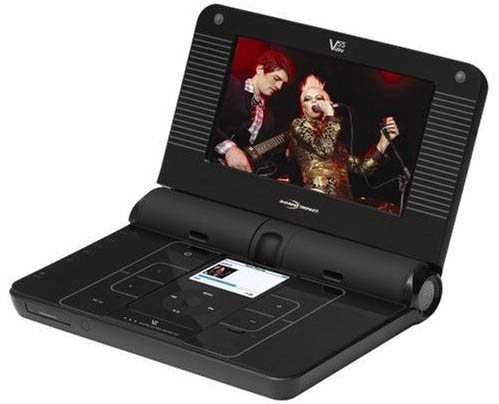
Sonic Impact V55 LCD display
AUDIO PERFORMANCE:
In the end, the upgraded required just a couple tools that I didn't already have lying around, and both were mentioned in the installation instructions. One was a torx-head driver bit (needed to remove the screws securing the drivers in the cabinets) and the other was a flexible extension for my drill so I could more easily get to the screws that secure the crossovers. Since I wasn't soldering the connections, I also needed a crimping tool in lieu of a soldering iron, but some digging around in my tools turned up one of those. The instructions and the video guide told me exactly what I needed to know before I sat down to start the installation process, and if I had done my own preparation properly to begin with I could have finished the entire thing in a single sitting (rather than two sessions spaced months apart).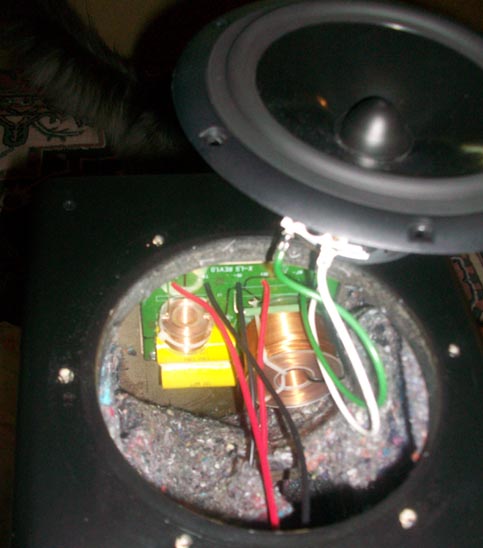
X-LS with original crossover
How did this upgrade sound, though? It had been too long for me to accurately remember what the system sounded like previously, but I had some other speakers readily at hand to help with comparisons and I had the main surround system in the living room as a good baseline. A few weeks after I finished the upgrade and burned in the new crossovers and tweeters, I set up the entire system at a wedding reception for one of my wife's co-workers. I ran both the X-LS and the B&W CDM1SE's off of the RR2150, and the receiver did an excellent job of driving both pairs of speakers at once while filling the large space (an old downtown loft art gallery space that was at least 40' wide and 60' deep) with clean, clear sound. Even though the room's acoustics weren't great and the source was an iPod in an Onkyo dock, the RR2150 did an excellent job playing at very high volume without any signs of strain or clipping. Of course, by setting this up we ended up with no access to the RR2150 or the X-LS's for over a week. Eventually, though we got the system back in place, by which time I had also picked up a pair of inexpensive 24" high stands for the X-LS's. The stands allowed me to space the speakers out enough to let them develop a decent sound stage.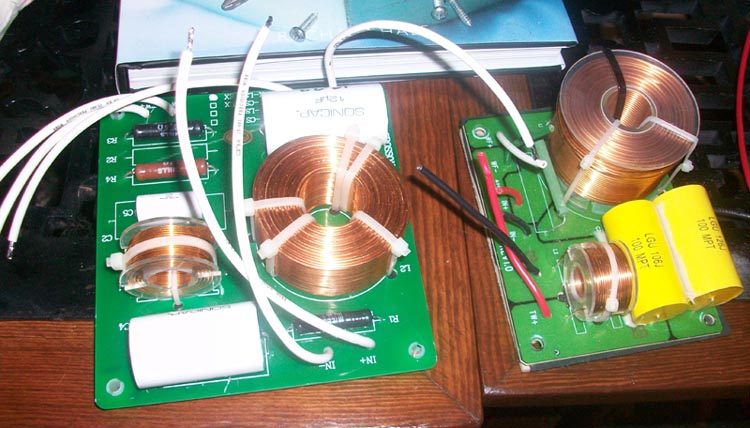
Crossover networks (Ninja on left, original on right)
With the speakers upgraded, burned-in, and on stands, it was a good time to start really listening. Even with the Ninja mod, this system doesn't offer the same level of clarity on musical instruments as the main system does (particularly when listening to percussion and strings), but that's to be expected when you consider the components in the main system. The differences between the system are reduced, though, which was the goal. Both male and female voices are presented well and listening fatigue isn't a problem. They do seem to take a little power to drive, which might be a problem for low-wattage systems (tube amps or something like the Sonic Impact T-Amp) but isn't a problem at all for the RR2150. It is still a good idea to take the grilles off for critical listening, as the grilles definitely muffle the sound some. For a total investment in the speakers of under $350 ($130 for the B-stock speakers and a bit over $200 for the mods) and a $170 disc player, the results are very respectable.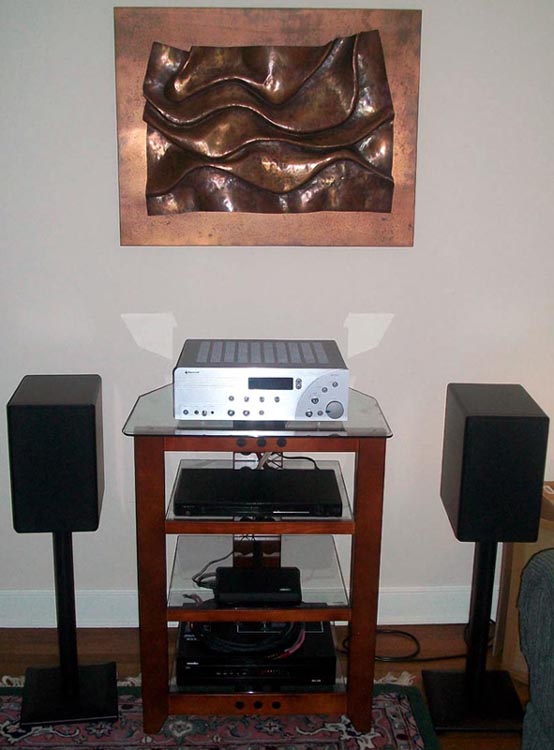
System with speaker stands and new equipment rack
CLOSING THOUGHTS:
EQUIPMENT LIST:
If you have any questions about this review, click here and I'll get back to you as quickly as I can.
[an error occurred while processing this directive] hits since December 21, 2007